Dog breeding licence fees have been a source of frustration for licensed breeders for years.
One breeder may pay a few hundred pounds. Another can face a bill of more than £1,000 for a licence issued under the same regulations.
It is tempting to describe this simply as a postcode lottery. But after looking more closely at the DEFRA dog breeding data, we think the bigger issue is transparency.
We can see what councils charge. What we cannot always see is how they arrived at that figure.
What has happened to dog breeding licence fees?
Under the Animal Welfare (Licensing of Activities Involving Animals) (England) Regulations 2018, local authorities report licensing information to the Secretary of State.
This includes the number of licences in force for each licensable activity and the average fees charged for licences granted or renewed. The current statutory guidance confirms that these figures are reported annually.
We reviewed the DEFRA returns specifically for dog breeding licences.
The reported average fee for a newly granted one-year dog breeding licence was:
| Reporting year | Average one-year new licence fee |
|---|---|
| 2022 | £440.10 |
| 2023 | £484.77 |
| 2024 | £488.10 |
| 2025 | £490.23 |
That is an increase of £50.13, or around 11.4%, between the 2022 and 2025 figures.
But the table needs some context.
The DEFRA dataset is compiled from information submitted by local authorities. DEFRA says it has not independently verified the figures and warns that some reported fees may include veterinary costs.
The number of councils submitting returns has also changed between years. This means comparing one national average with another does not necessarily compare exactly the same group of councils.
The number of licensed dog breeders has also changed
The same returns provide another useful figure: the number of dog breeding licences.
The totals reported were:
2022 – 1,975
2023 – 2,296
2024 – 2,224
2025 – 2,226
The 2024 figure is also confirmed in DEFRA’s post-implementation review of the regulations, which records 2,224 licensed dog breeders across 261 local authority areas on 1 April 2024.
Again, these numbers need to be read with care because the number of authorities submitting usable returns has varied.
They do, however, give us something important that broader animal licensing datasets cannot: these figures relate specifically to dog breeding licences.
How does the same licence cost so much more in one council?
Our review of the DEFRA returns shows considerable differences between individual councils.
The question is why.
Local authorities are allowed to charge for considering an application and carrying out inspections. They can also recover costs associated with compliance checks, certain enforcement work against unlicensed operators and compiling information required by the Secretary of State.
Current statutory guidance says councils must set fair and reasonable fees.
So a difference in price does not automatically mean one council is overcharging.
There could be several reasons for it.
A large kennel establishment with numerous breeding dogs, buildings and records may take considerably longer to inspect than a small home breeder.
The amount of officer time involved may differ. Administration may differ. Follow-up work may differ. And veterinary involvement can add another substantial cost.
This is where comparing the highest fee with the lowest fee stops being particularly useful.
We need to know what sits behind those figures.
Does the number of licensed breeders make a difference?
This is one question we think deserves closer examination.
Consider two councils.
One has only a handful of licensed dog breeders. Another regulates dozens.
It is reasonable to ask whether the scale of the licensing operation affects the amount each breeder ultimately pays.
But we cannot establish that by looking at the total number of animal activity licences in an area. Those totals can include boarding establishments, pet sellers, riding establishments and other licensed activities.
To test the idea properly, we need to compare the number of dog breeding licences in each council with that council’s reported dog breeding fee.
That is the comparison we are now making using the underlying DEFRA dog breeding returns.
It may show a relationship. It may not.
Either result would be useful.
Inspection time is another missing part of the picture
We have also been asking members of the My Licensed Breeder network about their inspection experiences.
Inspection times varied considerably, from a couple of hours to several hours. But another point came through in the responses: many breeders said a large part of the inspection was spent reviewing paperwork and records.
There could be several reasons for this.
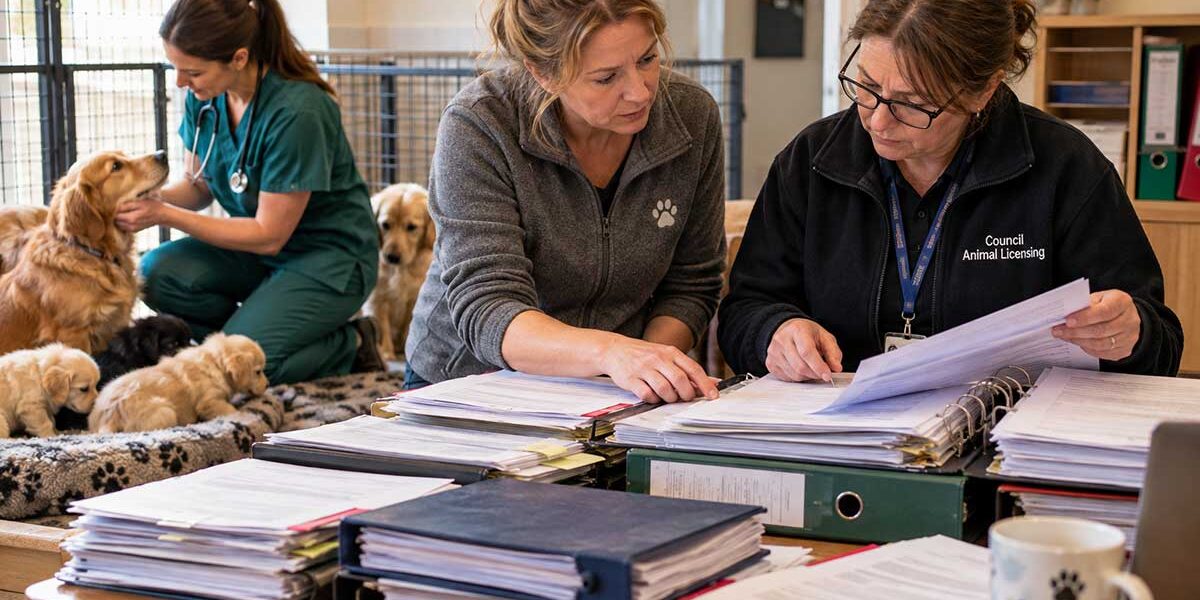
For many breeding businesses, paperwork is still exactly that: paper. Inspectors may have to work through folders containing policies, breeding records, health information, cleaning schedules, training records and other evidence before they can establish whether the licence conditions are being met.
The way those records are organised can therefore affect how quickly they can be checked.
This is something we have tried to address within the My Licensed Breeder network. We have standardised much of the paperwork used by members and moved it into an electronic format through the Digital PawPrint. Records and policies are organised consistently, and documents can be made available for an officer to review online before an inspection.
We also discourage members from building policies around lists of regulation or guidance paragraph numbers. A policy should explain what the breeder actually does, how they do it and what records provide the evidence. The inspector can then assess that practice against the relevant licensing conditions.
This raises another question when considering licence fees.
If a significant amount of officer time is spent making sense of paperwork, could better and more consistent record keeping reduce the time required for some inspections?
It won’t remove the need for an inspector to examine the establishment, speak to the breeder or verify records. Nor should it. But making evidence easier to find and review could allow more of the visit to concentrate on the dogs, their environment and whether the breeder is actually meeting the required welfare standards.
Inspection time is a cost. Making the inspection process more efficient could therefore benefit both councils and licensed breeders.
Veterinary involvement can add significantly to the cost
Another part of the licensing cost is veterinary involvement.
This shouldn’t simply be viewed as an additional administrative charge. Veterinary assessment can play an important role in licensing, particularly where professional judgement is needed about the health and welfare of dogs being used for breeding.
Recent Freedom of Information research by Naturewatch found that 64% of responding English councils indicated that an accompanying vet was involved when assessing compliance with breeding suitability requirements. Other councils referred to veterinary records, health testing and other forms of veterinary evidence.
We looked at this issue separately in our article on how councils assess whether dogs are suitable for breeding.
The 2025 DEFRA licensing returns also contain information about veterinary fees. The figures we reviewed show an average reported veterinary fee of £394.97, with reported figures ranging from £73 to £3,433.83.
That range deserves more examination. It does not necessarily mean councils or vets are charging wildly different amounts for exactly the same work.
The amount of veterinary involvement may differ depending on the establishment, the number of dogs being examined, the breeds involved, the evidence available and the purpose of the veterinary assessment.
There is also a problem when comparing the figures. DEFRA warns that some licence fees reported by councils may already include veterinary costs, while other authorities charge veterinary costs separately.
For breeders, this means the advertised licence fee may not represent the full cost of becoming licensed. It also means that comparing councils purely by their headline licence fee can be misleading.
How much is the licence?
It is:
What will the whole licensing process cost me?
What are councils allowed to charge for?
The current DEFRA guidance provides more detail than is sometimes recognised.
Under Regulation 13, local authorities can charge fees for considering an application, including inspections.
They can also recover costs for compliance checks on existing licence holders, including inspections, DBS, enforcement against unlicensed operators carrying out licensable activities, and compiling and submitting information required by the Secretary of State.
This is important when looking at apparently high fees.
A licence fee isn’t necessarily just the price of an inspector visiting a breeder’s home or kennels for a couple of hours.
But that creates another question.
How much of each council’s fee relates to each of those activities?
There is another part of the fee that licensed breeders may not immediately associate with their own licence.
Local authorities can recover certain costs connected with enforcement against unlicensed operators carrying out licensable activities.
This means the fee isn’t necessarily based only on the time an officer spends processing your application and inspecting your premises. A council dealing with a significant amount of suspected unlicensed activity may have additional enforcement costs within its animal licensing service.
This could potentially help explain why some areas are more expensive than others, although the licence fee alone cannot tell us whether that is the reason.
It also creates an interesting issue for licensed breeders. Part of the cost of operating legally may contribute towards the council’s work investigating businesses that should be licensed but are not.
That isn’t necessarily unreasonable. Enforcement is part of making the licensing system work. But if those costs contribute significantly to the fee, councils should be clear about it.
Does a high fee mean a council is making money?
Not necessarily.
A £1,000 fee looks expensive when another authority charges a few hundred pounds.
But price alone cannot tell us whether the first council is recovering legitimate costs, operating inefficiently or collecting more than the licensing process costs it.
We would need considerably more information to answer that.
We would want to know the number of licensed breeders, officer hours, administration time, inspection duration, veterinary costs, follow-up work, enforcement costs and how the council calculated the final fee.
Without that information, claiming that an expensive council is making money from licensing would go further than the available evidence supports.
Equally, councils charging substantially more than the national average should be able to explain why.
Other organisations have identified problems with the data
The Pet Industry Federation has separately analysed local authority animal licensing returns and raised concerns about incomplete submissions, inconsistent reporting and the difficulty this creates when comparing councils over time.
Its analysis covers the wider animal activities licensing system rather than our narrower examination of dog breeding fees.
PIF found that not every council submitted usable information every year and called for more consistent reporting and standardised authority identifiers.
We have not reproduced PIF’s member analysis here.
Instead, our figures come from the underlying DEFRA returns and concentrate specifically on dog breeding.
The public DEFRA dataset is available under the Open Government Licence and contains both the number of licences in force for each activity and average fees reported by individual authorities.
What information is still missing?
This is where we think the discussion about licence fees needs to go next.
Publishing a list of the cheapest and most expensive councils is easy.
Understanding why they are different is harder.
For a meaningful comparison, we would want to know the number of dog breeding licences in each authority, whether an application is new or a renewal, inspection duration, whether veterinary costs are included or separate, the actual veterinary charge and how the council calculated its fee.
We can already answer some of those questions from the DEFRA data.
Others will require more information from councils.
Councils could make this much easier
There is a relatively simple way to improve confidence in the system.
When a council publishes its dog breeding licence fee, it could also publish a basic explanation of how that fee has been calculated.
Breeders could then see what they are paying for and what additional costs might arise.
This would help councils too.
If an authority charges considerably more than its neighbours but can demonstrate that the fee reflects the reasonable cost of delivering the licensing service, it has an answer when challenged about the difference.
And if the figures cannot be explained, that deserves further examination.
So is there a dog breeding licence postcode lottery?
There is certainly a large difference in what breeders can pay depending on where their business is based.
But variation is not the same as evidence of unfair charging.
The DEFRA data tells us what councils report charging. It tells us how many dog breeding licences are in force. And it gives us some information about veterinary costs.
What it doesn’t yet give us is a clear enough picture of how each council turns the work involved in licensing into the final bill received by a breeder.
That is the gap we want to explore next.
Data and Sources
The licence and veterinary fee figures used in this article have been taken from DEFRA’s Local Authority Licensing of Activities Involving Animals annual returns. Our analysis relates specifically to dog breeding licences, rather than all animal licensing activities.
The figures are supplied to DEFRA by individual local authorities and have not been independently verified by DEFRA. The number of authorities providing usable information can also vary between reporting years, so year-on-year comparisons should be treated with some caution.
We have also referred to the Pet Industry Federation’s Local Authority Animal Licensing Analysis Report 2023–2025 for wider context around local authority reporting and data quality. PIF’s analysis and tables have not been reproduced here.
Comments about inspection times and paperwork are based on a recent informal survey of members of the My Licensed Breeder network and should not be treated as a representative national sample.
DEFRA dataset: Local Authority Licensing of Activities Involving Animals Returns