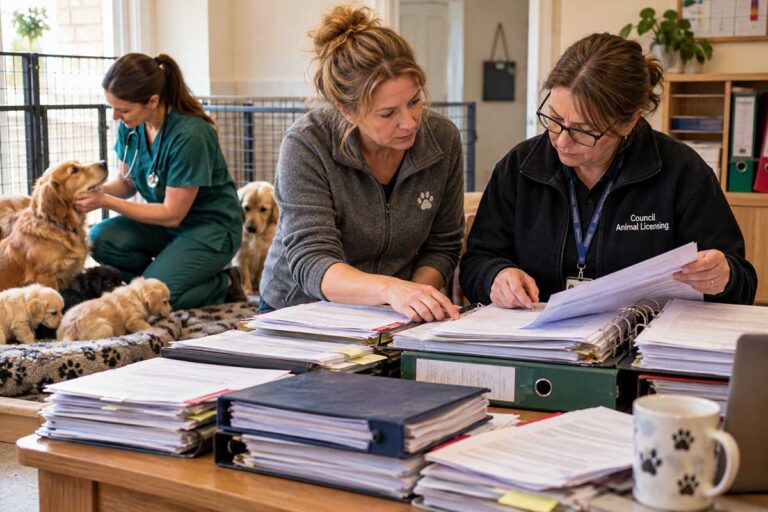
A new report into how local authorities assess licensed dog breeders in England and Scotland has raised important questions about how breeding suitability is assessed by enforcement officers.
It focuses on whether local authorities are using existing regulations and guidance effectively to prevent dogs being bred where their health, welfare, genotype, phenotype, conformation or behaviour could put them or their puppies at risk.
Obviously an important discusssion. No responsible breeder should object if there is evidence that breeding from a dog could cause avoidable harm. However, much of the discussion around the report appears to focus on variation between councils, as though variation itself is evidence of failure.
However, one of the most important findings in the report is that a majority of English councils who responded indicated that veterinary assessment was involved when considering breeding strategy, or at least that’s how it reads.
For compliance and licensing, there are no quick-fix tools that can replace a professional examination with experienced veterinary advice and recorded evidence. Visual tools such as the IHAcan be useful for the public. They can help puppy buyers ask better questions about certain breeds, visible traits and potential welfare risks.
But licensing decisions are different. They can affect livelihoods, local authority reputations and potential legal proceedings. In that context, local authorities appear to be doing the right thing by relying on professional judgement, veterinary input, statutory guidance and evidence-based records.
Does variation automatically mean failure?
A local authority with a small number of lower-risk licensed breeders, for example working gundog breeders with no obvious conformation concerns, may not need to approach inspections in the same way as an authority dealing with breeds affected by exaggerated features, inherited disease risks or repeated welfare complaints.
Different local authorities may have different breeder numbers, different breed profiles, different complaint histories and different levels of local risk. That does not mean the law should be applied inconsistently, but it does mean the evidence needed in each case may not always look the same.
If we want more breeders to support licensing, join the regulated system and work openly with their local authority, reports like this need to be interpreted with care. More recommendations alone will not solve the problem unless they come with practical ways for breeders and councils to evidence, review and understand compliance consistently.
What does the report actually say?
The report looks at how local authorities in England and Scotland assess whether licensed dog breeders are complying with rules designed to prevent harmful breeding decisions.
In England, this relates to schedule 6, paragraph 6(5) of the Animal Welfare (Licensing of Activities Involving Animals) Regulations 2018.
In Scotland, it relates to the equivalent provision under schedule 6, paragraph 8(5) of the 2021 regulations.
In simple terms, these rules say that a dog should not be kept for breeding if it can reasonably be expected that breeding from that dog could have a detrimental effect on its own health or welfare, or the health or welfare of its offspring.
The report focuses on areas such as genotype, phenotype, conformation, behaviour, general health, inherited disease and exaggerated physical traits.
What evidence supports the report?
The report is based on Freedom of Information responses from local authorities.
It says there were approximately 2,390 licensed dog breeders across England and Scotland in the second half of 2025, with 2,217 in England and 173 in Scotland.
It found that councils use a range of approaches when assessing compliance. Around 60% said they rely on veterinary advice during inspections. Other approaches included reviewing veterinary records, examining breeder records, looking for health testing, consulting external sources such as the Royal Kennel Club, drawing on licensing officer experience, reviewing policies and considering temperament or behaviour.
What do the FOI findings really show?
The report does not show that most local authorities are failing to take these issues seriously.
In fact, the most common response from English councils was reliance on veterinary assessment, with 64% indicating that an accompanying vet was involved in assessing compliance.
The report also acknowledges that this figure could be higher where councils said they follow statutory guidance but did not explicitly mention veterinary involvement.
Other councils referred to veterinary records, breeder records, health testing, statutory guidance, Royal Kennel Club information, licensing officer experience and policy review.
The picture is therefore more nuanced than a simple claim that councils are not acting. It suggests many are already using professional input, but the way evidence is recorded, structured and presented may vary considerably.
The negative finding is not necessarily that most local authorities are failing. It may be that some local authorities gave limited FOI responses with very little detail about how they assess compliance.
A short or unclear FOI answer is not the same as evidence that no proper assessment is taking place in practice.
If many councils are already using vets, statutory guidance, veterinary records, health testing or other evidence-based routes, then the next step should be to understand the gaps in the remaining responses.
Are they genuine gaps in enforcement, poor recording, limited FOI wording, no current licensed breeders, outsourced inspections or lower-risk local breeder profiles?
If reports like this are going to shape future policy, they need to be careful not to turn limited responses from some local authorities into a wider suggestion that the licensed sector, or the councils regulating it, are broadly failing.
Are councils using visual tools such as the Innate Health Assessment?
There is nothing in the report to suggest that local authorities are relying on visual assessment tools such as the Innate Health Assessment when assessing breeding suitability.
There are, however, signs that some councils are beginning to reference such tools in their public-facing information. That raises a separate question: if external tools are going to sit alongside licensing decisions, how are they being governed, reviewed and communicated to local authorities?
Tools such as the Innate Health Assessment can have value for the public. They can help puppy buyers and dog owners ask better questions about certain breeds, visible traits and potential welfare risks. Used in that way, they can support education and encourage people to look beyond appearance when choosing a dog.
However, there is a difference between a public awareness tool and a tool that influences licensing decisions. When a local authority is considering a breeder’s licence, the consequences are far more serious. A decision may affect a person’s livelihood, the reputation of the local authority and, in some cases, future legal action.
That is why visual tools should not become an automatic conclusion. They may help identify questions that need to be asked, but those questions should then be tested against veterinary evidence, genetic testing, health records, breeding history and professional judgement.
The merle criterion shows why evidence matters
The recent update to the IHA merle criterion is a useful example of why caution is needed.
The IHA team has amended its position so that dogs displaying visible merle colouration may receive a conditional pass for breeding purposes, provided genetic testing is carried out and the breeder gives a written commitment that the dog will only be mated to a partner confirmed not to carry merle-associated variants.
This is a more evidence-led position than a simple colour-based judgement.
The welfare risk is not simply the presence of merle colouration. The risk comes from breeding decisions, genetic status, partner selection and whether the breeder has evidence to support the mating. In particular, the concern is around double-merle matings, which can increase the risk of serious eye and hearing problems.
It is welcome that the criterion has been reviewed, but it also raises an important governance question.
If a tool is already being used by local authorities as part of animal licensing inspection work, what happens when a criterion changes?
If a breeder had been marked down, refused, varied, suspended or revoked under an earlier interpretation, the consequences could be significant. There should be clear version control, transparent communication with local authorities, and a route for breeders to provide further evidence or request a review where criteria change.
For the public, tools like this can help people ask better questions. For licensing, they should be used with caution. They should support professional examination, not replace it.
Why is the focus still falling on the licensed sector?
One question that needs to be asked is why so much pressure appears to be focused on local authorities and licensed breeders, when this report itself shows that many councils are already using professional veterinary input, statutory guidance and evidence-based routes when assessing breeding suitability.
We know the licence system is not perfect. There will always be areas where guidance, recording, officer training and consistency can improve.
But if the majority of councils who responded are already involving vets, then the discussion shouldn’t be framed as though local authorities are broadly failing or ignoring welfare concerns.
We should ask where the real gaps are. Are the problems inside the licensed system, or are they also being driven by unlicensed breeding, poor buyer awareness, online sales, imported puppies and a lack of public understanding about inherited disease and exaggerated conformation?
With the Government expected to consult on dog breeding reform, it is reasonable to ask whether reports highlighting local authority practice are also helping shape a wider direction of travel.
If they are, then breeders, vets, local authorities and the systems already supporting traceability and compliance need to be part of that conversation.
What is the point?
The Naturewatch report raises important questions, but it should not be used to create the impression that most local authorities are failing to act.
The report confirms that a majority of English councils who responded are relying on veterinary assessment, and the figure may be higher where councils referred to statutory guidance without specifically mentioning veterinary involvement.
That should be recognised as a positive finding.
The remaining questions are about the quality of evidence, how councils record their approach, how breeders present their records, and how future tools are governed if they are used in a licensing context.
There are no quick fixes in licensing. Public-facing tools can help buyers ask better questions, but decisions about breeding suitability should be based on professional examination, veterinary input, statutory guidance, genetic evidence where relevant, breeding records and clear audit trails.
Surley, the aim is about better welfare and does the sector need another report and another list of recommendations. It needs practical systems that help responsible breeders evidence compliance and help local authorities review that evidence consistently.
Licensed breeders should not just be the focus of the discussion. They should be part of the solution.
Read the report here: https://naturewatch.org/concerns-over-enforcement-of-dog-breeding-welfare-rules/