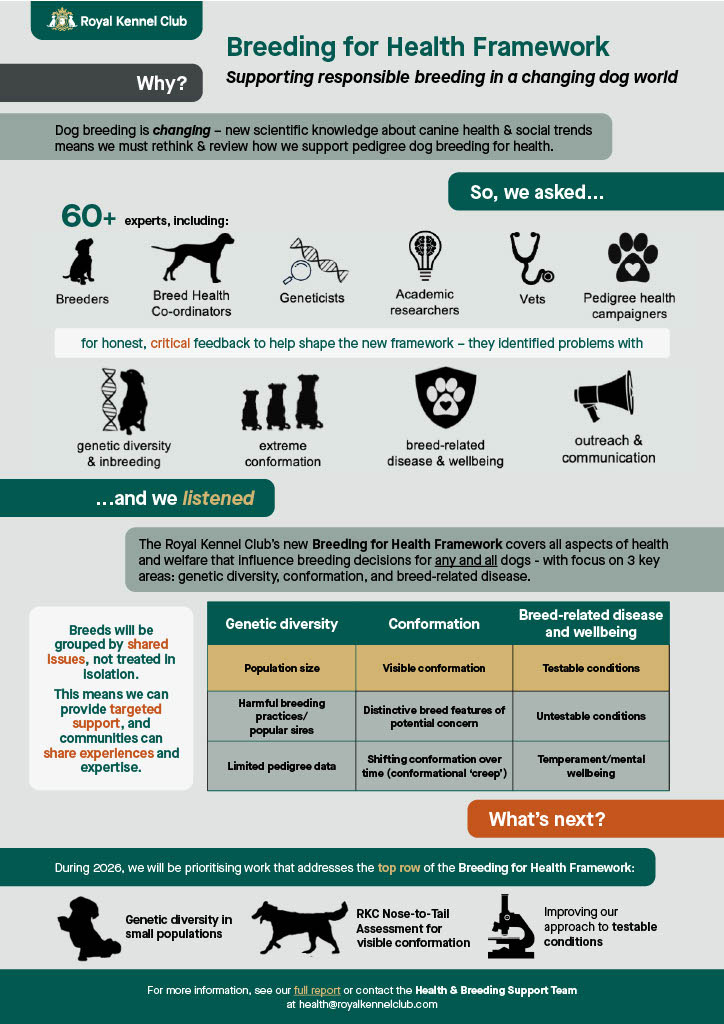
My Licensed Breeder has reviewed the Royal Kennel Club’s Breeding for Health report and broken it down into clearer, more digestible information for breeders. The report itself follows wide stakeholder engagement, including input from breeders, vets, scientists, and welfare groups. For breeders who already work within a licensing and inspection framework, the report is useful not because it changes the rules, but because it highlights where expectations and influence are now shifting. The report is not about licensing or enforcement. It is about how the RKC believes dog breeding culture, health tools, and education need to change.
Below is a clear summary of the main problems the report identifies, followed by what the RKC says it will do in response.
1. Loss of genetic diversity
The issue
The report accepts that many pedigree breeds have reduced genetic diversity. This is linked to:
-
- Small breeding populations.
- Overuse of popular sires.
- Historic inbreeding practices.
Closed registers that limit new genetic input
The report is frank that reduced diversity is linked to poor fertility, higher disease risk, and reduced lifespan in some breeds.
What the RKC says it will do
- Focus more clearly on genetic diversity, not just disease testing.
- Provide better education on managing diversity in breeding decisions.
- Support breed-led strategies where diversity is a problem.
Be open to controlled solutions such as using related populations or, where justified, structured outcrossing programmes
This is framed as targeted support, not a blanket change across all breeds.
2. Harmful breeding practices, especially popular sires
The issue
The report identifies popular sire use as a major driver of genetic loss. In some breeds, a small number of dogs have produced a disproportionate number of puppies.
This concentrates risk, even when the sire appears healthy.
What the RKC says it will do
- Improve visibility of sire usage data
- Educate breeders on long-term population impact
- Explore tools to flag or limit excessive use where needed
- Consider further governance only if education alone does not lead to improvement
Importantly, this is described as breed-specific, not universal.
3. Extreme and worsening conformation
The issue
The report accepts that extreme conformation remains one of the RKC’s biggest reputational and welfare problems. It also recognises that harm can increase gradually through what is described as “conformational creep”, even before dogs reach obvious extremes.
External experts were clear that this remains an area of concern, particularly where physical traits are linked to disease or impaired function.
What the RKC says it will do
- Develop a Nose-to-Tail visual assessment carried out by veterinary professionals
- Use this to monitor physical traits linked to welfare concerns
- Intervene earlier where conformation is shifting in a harmful direction
- Continue to evolve Breed Watch rather than rely on show outcomes alone
This is positioned as monitoring and prevention.
4. Breed-related disease and the limits of current tools
The issue
The report highlights that many serious health problems are not currently testable. These include some cancers, autoimmune diseases, and complex conditions with no simple screening tool.
It also accepts that reliance on traditional clinical screening and visual assessment alone can miss underlying genetic risk. In some cases, dogs may appear healthy while still carrying or concentrating inherited problems within a population.
What the RKC says it will do
- Continue to expand and refine the use of DNA testing where it is scientifically valid
- Improve how genetic data is used, not just collected
- Use tools such as coefficient of inbreeding calculations, estimated breeding values, and population genetics metrics alongside clinical tests.
- Keep untestable conditions visible within breed health planning rather than ignoring them
- Support further research to develop more accurate genetic tools
Review how mandatory testing might be used more carefully and proportionately, rather than as a blunt instrument
The report is clear that DNA testing is valuable, but not a complete solution on its own. It is positioned as one part of a wider, evidence-led approach to risk reduction, rather than a guarantee of health.
Crucially, the report stresses that education matters more than simply mandating more tests. Without breeders understanding how to interpret results, manage risk, and balance competing factors, additional testing alone risks becoming a box-ticking exercise rather than a genuine welfare improvement.
The issue
The report highlights that many serious health problems are not currently testable. These include some cancers, autoimmune diseases, and complex conditions with no simple screening tool.
There is concern that focusing only on testable conditions gives a false sense of security.
What the RKC says it will do
- Keep untestable conditions visible within breed health planning.
- Improve how disease severity is factored into priorities.
- Continue supporting research to develop better tools.
- Review how mandatory testing might be used more carefully and proportionately.
5. Temperament and mental wellbeing
The issue
The report accepts that breeding decisions have historically focused on physical traits, often at the expense of behaviour and mental wellbeing.
Behavioural problems are identified as a major welfare issue and a common reason for rehoming and euthanasia.
What the RKC says it will do
- Explicitly include temperament and mental wellbeing within the framework
- Begin developing better educational material in this area
- Treat behaviour as a welfare issue, not just a training issue
This is described as an early step, not a finished solution.
6. Poor accessibility of health information
The issue
Stakeholders repeatedly told the RKC that existing health information is:
- Hard to find
- Too technical
- Poorly suited to new or first-time breeders and puppy buyers
What the RKC says it will do
- Simplify how breed health information is presented
- Develop clearer, standardised summaries for each breed
- Improve outreach through education and public-facing material
- Strengthen engagement with the veterinary sector
7. The Health Standard and timing of reform
The report sits alongside work the RKC has already started. In particular, the RKC introduced its Health Standard ahead of Crufts last year. This marked a shift towards clearer, more visible expectations around health testing, genetic data, and transparency for both breeders and puppy buyers.
This timing is important. It shows that the Breeding for Health Framework is not a sudden change of direction, but part of a longer move towards education-led improvement rather than reactive reform. The Health Standard laid the groundwork by making health information easier to access and compare, while this report focuses on the wider structural issues that sit behind those results
Why this shift is happening now
It is reasonable to view this report in the context of pressure the RKC has faced over the last decade.
Pedigree breeding has been subject to sustained criticism from welfare groups, the veterinary profession, and the media, particularly around extreme conformation and inherited disease. That criticism has not gone away, and the report openly acknowledges the reputational damage this has caused.
Alongside this, the RKC’s previous Accredited Breeder Scheme was widely seen as failing to provide a clear or credible marker of good practice. Its abolition left a gap. There was no longer a visible, trusted way for breeders or puppy buyers to distinguish between baseline registration and demonstrably higher standards.
The introduction of the Health Standard ahead of Crufts last year, followed by the Breeding for Health Framework, can be read as a response to that gap. Rather than relying on branding or voluntary badges, the RKC is shifting towards clearer data, transparency, and education-led signals around health and breeding decisions.
Seen this way, the framework is less about reacting to a single piece of bad press and more about rebuilding trust and relevance in a sector where expectations have changed.
The Innate Health Assessment and conformation tools
It is also worth noting the wider context around conformation assessment tools.
The Innate Health Assessment (IHA), developed through the All-Party Parliamentary Group on Animal Welfare, is referenced in the report as a self-assessment tool intended for licensed breeders and puppy buyers. The Royal Kennel Club had input into discussions around this work but did not publicly adopt or promote the tool.
This matters because, within the report, the RKC sets out plans to develop its own Nose-to-Tail visual assessment, to be carried out by veterinary professionals and integrated with existing RKC systems such as Breed Watch.
Read together, this suggests a deliberate decision by the RKC to retain control over how conformation is assessed, interpreted, and acted upon, rather than endorsing an external tool over which it has limited governance.
The Breeding for Health Framework appears to provide the strategic context for that choice, setting out a clearer internal pathway for conformation monitoring that aligns with the RKC’s data, expertise, and influence.