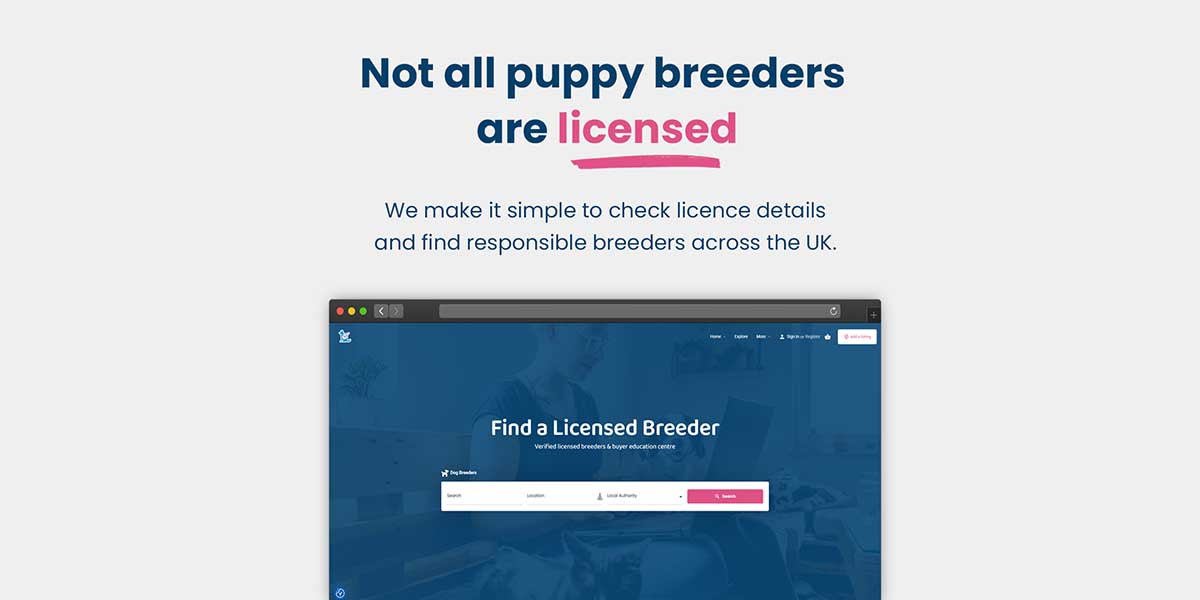
We recently created a simple advert aimed at breeders. It wasn’t promotional. It was research.
We wanted to understand how licensing is perceived across the dog breeding sector. What objections are raised? Where do they come from?
And is there space for a constructive, evidence-based discussion?
Over the past few years, we have carried out two structured surveys to understand breeder attitudes toward licensing, inspection, compliance, and enforcement. Those surveys provided useful insight, but they also had limitations. Formal surveys tend to attract people who are already engaged and comfortable sharing their views in a structured setting.
This time, we wanted to observe something different. We wanted to see how licensing was discussed in a wider, less controlled environment.
So we took the conversation to social media.
How the adverts were targeted
The adverts were written in a neutral, buyer-facing style but were delivered using standard digital targeting tools. They were shown specifically to people with clear interests or engagement linked to dog breeding.
This meant the general puppy-buying public was not the primary audience. The aim was to observe breeder responses in an open, public setting and not to influence buyers or create artificial debate.
All engagement took place on public posts attached to our own adverts. No private groups were accessed, and no attempt was made to steer discussion. The objective was simple: to see how licensing is discussed when it appears in a neutral context.
The advert and post called for viewers to opt for licensed dog breeder when choosing their puppy. What came next were mainly objections to choosing a licened breeder. These objections came mainly from unlicensed breeders associated to showing dogs.
Top Objections to Dog Licensing
The following objections were consistently raised.
1. Licensed breeders are puppy farms and commercial breeders
This was one of the most common claims. So what are the facts?
National licensing data shows that the majority of licensed breeders operate with relatively small numbers of breeding females. Larger, high-capacity licences do exist, but they represent a minority rather than the norm.
A small number of larger establishments heavily influence perception. Their visibility creates the impression that licensing is synonymous with industrial-scale breeding. It is not.
Breeding dogs for sale is legal in the UK and Ireland. Licensing exists because it is legal, not to enable illegality, but to regulate and monitor it.
However, it is illegal to breed dogs as a business without a licence.
A recurring confusion in the comments was between breeding dogs and selling animals as pets. These are regulated as separate activities, with different licence conditions and different risk profiles.
Many of the practices people object to such as large-scale selling, third-party sales and cross-border movement sit within selling and movement controls rather than breeding licences.
Confusion between these licence types has fuelled misinformation about what breeding licences actually regulate.
Some comments referenced historical practices involving the importation of puppies. Those practices were enabled by gaps in movement regulation, not by breeding licences themselves. Subsequent import and export legislation has tightened traceability and restricted commercial movement.
This reflects how regulation evolves over time. It does not demonstrate that licensing itself is flawed.
2. I don’t need a licence because I only breed occasionally
This objection appeared frequently. So what are facts?
In England, producing three or more litters within a 12-month period automatically requires a licence. However, breeders producing fewer litters may still require a licence if they meet the business test.
The business test does not depend solely on litter numbers. It considers whether breeding activity shows indicators of being carried on as a business — such as advertising, frequency, financial turnover, and commercial intent.
There has been some confusion online around the idea of a “£1,000 threshold”. It is correct that £1,000 does not appear in the licensing regulations. However, £1,000 is the HMRC trading allowance. Earning above that amount does not automatically require a breeding licence but it can be an indicator that activity is no longer purely private or incidental.
In any investigation into whether breeding is being carried on as a business, tax and trading indicators may be considered alongside regulatory criteria.
Other UK nations operate under different thresholds and tests, but the principle is broadly consistent: occasional breeding does not automatically remove the need for licensing. The key question is whether the activity amounts to a business.
This is where the debate often becomes uncomfortable.
Breeding “for the love of the breed” and operating in a commercial marketplace are not mutually exclusive. Based on our review of public listings, the current average sale price of a puppy is around £1,300. Average litter sizes are typically between six and eight puppies.
At those levels, a single litter could generate gross revenue of approximately £7,800 to £10,400.
That figure represents turnover, not profit. Costs such as health testing, veterinary care, food, insurance, and general husbandry can be deducted unless the breeding bitch is considered a family pet.
However, the business test does not depend on profit alone. It considers whether the activity is organised, advertised, and producing meaningful financial return.
This is precisely why the business test exists. It recognises that commercial activity is not defined only by litter numbers, but by overall indicators of trade.
Passion for a breed does not remove commercial responsibility. Where significant income is being generated, licensing, regulatory compliance, and tax obligations are not punitive they are part of operating transparently.
If breeding is genuinely occasional and non-commercial, the financial and behavioural pattern will reflect that. Where structured selling and sustained income are present, oversight functions as accountability rather than punishment.
3. Licensing is just a money-making scheme for councils
This objection was repeated frequently. So what are facts?
The perception is that licensing fees are designed to generate income rather than protect welfare. In reality, licensing fees are legally required to reflect the cost of administering and enforcing the regulations. They are not intended to generate profit.
Inspections involve officer time, administrative processing, record review, complaint handling, and, in many cases, veterinary input. Where enforcement action is required, additional legal and investigative work follows.
It is also important to recognise that not all local authorities have large numbers of breeders within their area. In regions with relatively few licensed establishments, councils cannot justify maintaining highly specialised in-house breeding teams. As a result, some authorities outsource veterinary inspections or specialist input. That outsourcing is reflected in the overall cost structure.
Fees vary between local authorities, which can fuel suspicion. However, variation often reflects differences in local demand, staffing models, outsourcing arrangements, and enforcement capacity rather than a coordinated attempt to generate revenue.
The broader question is not whether licensing carries a cost? it clearly does, but whether oversight and accountability should exist at all.
Any regulatory framework requires administration. Removing it would not remove cost; it would remove oversight.
4. Councils don’t understand breeding
This concern surfaced regularly.
Some breeders expressed the view that inspectors lack practical breeding experience and therefore cannot fairly assess standards.
Since the May 2025 updates to local authority guidance, greater emphasis has been placed on officer training, competence, and the use of veterinary expertise. Inspectors are expected to be appropriately trained, and where specialist knowledge is required, authorities are advised to consult with or involve veterinary professionals.
Licensing inspections are carried out by officers operating under statutory guidance. Their role is not to assess breeding style or personal philosophy. It is to assess compliance against defined welfare standards.
The framework does not require inspectors to be breeders. It requires them to be competent to assess:
- animal welfare conditions
- housing and environmental standards
- health management
- record keeping
- compliance with licence conditions
The question often posed is: must someone breed dogs to understand poor welfare?
Welfare assessment is not based on show-ring success or breeding reputation. It is based on observable, measurable standards, space, hygiene, socialisation and health indicators, environmental enrichment, and veterinary oversight.
There is room for discussion about consistency between authorities and the depth of training provided to inspectors. Those are legitimate areas for improvement. Variation in practice between councils has been acknowledged within the sector and the guidelines are being updated all the time.
However, variation does not invalidate the principle of independent oversight.
Regulation is designed to establish and enforce minimum welfare standards. It is not intended to adjudicate breeding philosophy, bloodlines, or personal approaches to husbandry.
Where disagreement exists, it is often about interpretation and not about whether welfare should be monitored at all.
6. Licensing punishes small, responsible breeders
Some responses suggested that licensing unfairly targets small-scale or hobby breeders while allowing larger operators to continue.
The licensing framework is not based on scale alone. It is based on activity and commercial intent.
Small breeders operating as a business fall within scope. Large breeders operating legally and meeting conditions also fall within scope.
The principle is consistent: if breeding is carried out as a business, minimum welfare standards apply.
The discomfort expressed in some responses appeared less about welfare conditions themselves and more about the formalisation of activity that had previously operated informally.
5. Licensed dog breeders forge pedigree paperwork
A small number of comments raised concerns about pedigree paperwork, specifically claiming that registration documents can be inaccurate or that recorded parentage may not always be independently verified.
It is important to be precise about what this concern relates to.
Pedigree documentation relates to:
- Lineage
- Ancestry
- Registration status
- Parentage declarations
This issue highlights an industry- and sector-wide problem as opposed to something specific to licensed breeders. If it were limited only to licensed breeders, it would account for less than 20% of dogs sold, as the remaining 80% come from unlicensed breeders.
These systems rely on record submissions by the breeder and, in some cases, DNA verification. They are primarily concerned with genetic traceability and breed registry, not welfare regulation.
If someone believes pedigree paperwork can be misused, that concern applies to registration systems generally. It is not specific to licensed breeders.
More importantly, pedigree paperwork is not what licensing is built upon. Licensing paperwork is not a certificate handed to a buyer. It is a compliance framework that sits behind the operation and verfied during inspections and follow-ups with vets.
What Did We Learn?
The objections raised were not random, and they were not irrational. They followed consistent themes: profit versus income, family pets versus business activity, pedigree paperwork versus welfare licensing, and frustration at perceived inconsistency between councils. But beneath those themes sits something deeper a cultural resistance to external oversight in a sector that has historically regulated itself through reputation and peer networks.
Licensing does not ask whether a breeder loves their dogs. It does not judge show results, bloodlines, or intent.
It asks a simpler question: is this organised, income-generating activity taking place within a regulated marketplace?
Where it is, minimum standards apply. That principle is neither radical nor complex particularly when compared to other care sectors where inspection and documentation are routine.
Much of the resistance appears to stem from confusion between licence types, misunderstanding of the business test, and simplified interpretations of legislation repeated within online communities.
The real lesson is this… transparency challenges culture more than it challenges welfare. And when culture feels challenged, the reaction is often framed as defence of principle even when the underlying issue is governance.
Resources: